Automate geomagnetic inspection and calibration — field calibration to a controlled magnetic field environment
Cutting Heading-Related Field Returns by About 50%, with Full Post-Calibration Verification
- Customer: Long-range, wide-area drone manufacturer
- Solution: DRQC_03 (Magnetometer Inspection and Calibration)
At a glance
- Heading-related field returns reduced by approximately 50%
- A repeatable calibration environment with external magnetic interference minimized
- Full verification of whether post-calibration error meets the set tolerance, on every unit
Background & Challenges
This manufacturer was experiencing recurring heading errors and path deviations in flight on some of its aircraft.
During root-cause analysis, calibration variation in the magnetometer was identified as one of the main contributing factors. A magnetometer is sensitive to the magnetic fields created by nearby metal or electrical currents. When an operator calibrates by manually rotating the aircraft in an ordinary environment, measurement conditions change with the surrounding equipment and location, and repeating the same procedure can still produce varying results. In particular, a fully assembled aircraft introduces magnetic effects from the airframe itself, which made establishing a consistent calibration baseline a challenge.
Solution and Deployment Effectiveness
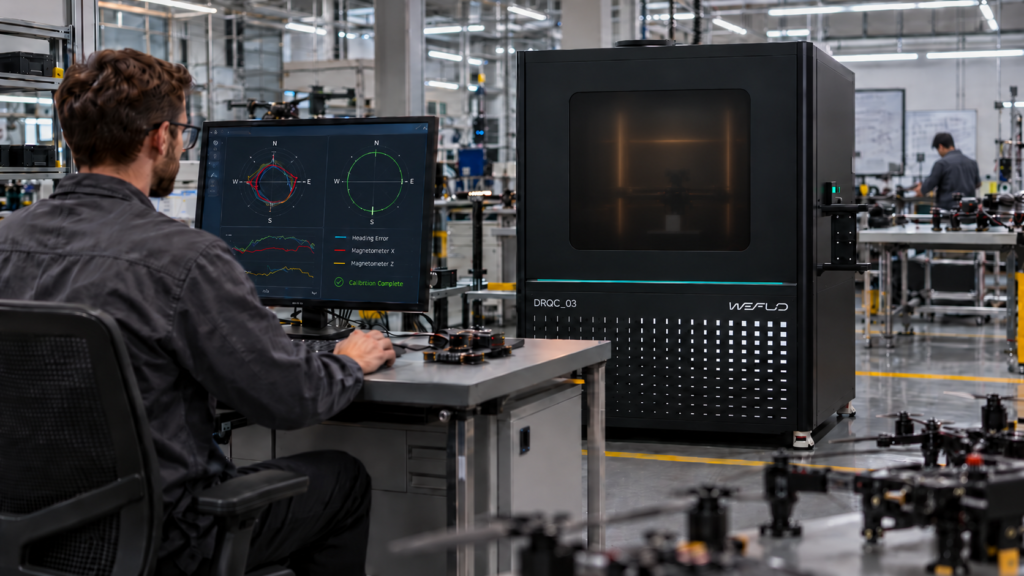
DRQC_03 generates a controlled magnetic field inside a chamber that minimizes external magnetic interference,
then measures and calibrates the magnetometer’s response. After correction, it re-measures under the same conditions and automatically verifies whether the error meets the defined tolerance. This reduces calibration variation caused by location and operator, and supports magnetometer inspection and calibration across a range of forms, from multirotors and fixed-wing aircraft to fully assembled units and the flight controller level.
After adoption, heading-related field returns fell by about 50%. By applying the same calibration and verification procedure to every aircraft under controlled conditions, the manufacturer also established a way to catch heading errors before shipment that had been difficult to reproduce in the field.
Key Insights
In magnetometer calibration, the consistency of the calibration environment matters as much as the precision of the sensor itself. Accurate calibration begins less with how well the aircraft is rotated than with how precisely the same magnetic field conditions are reproduced every time.