Automating IMU Inspection & Calibration — Robotics-Based Aircraft Positioning
80% Reduction in IMU Calibration Time, 60% Fewer Attitude- and Drift-Related Early Defects
- Customer: Multi-platform drone manufacturer, including medium- and large-sized UAVs
- Solution: DRQC_02 — IMU Inspection & Calibration
At a Glance
- IMU calibration time: 15 min → 3 min (80%↓)
- Large UAV calibration: 2-person manual process → automated calibration
- Attitude- and drift-related early defects: ~60%↓
Background & Challenges
The manufacturer relied on operators to manually reposition and rotate each aircraft during IMU calibration.
Accelerometer calibration required the aircraft to be positioned precisely in multiple orientations, while gyroscope response had to be verified under controlled rotational conditions. Reproducing these positions and movements by hand was time-consuming and introduced operator-to-operator variation. For fully assembled medium- and large-sized UAVs, two operators were often required to handle the aircraft, turning the calibration process into a production bottleneck as volumes increased.
Solution & Results
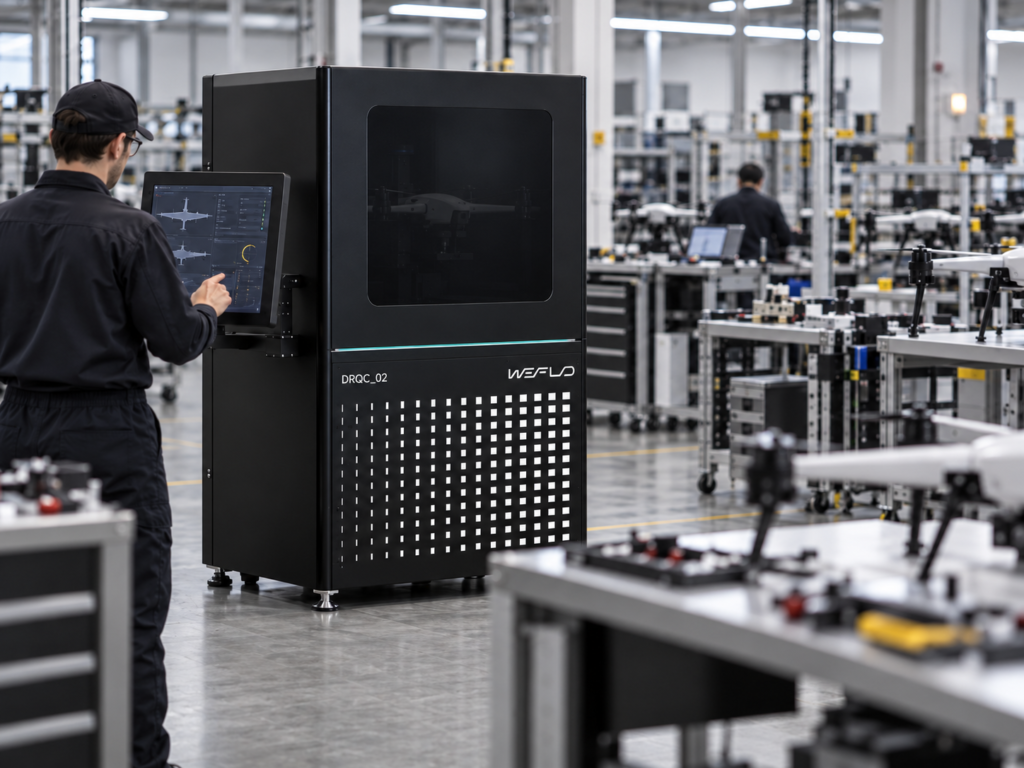
DRQC_02 automates the aircraft positioning and rotation previously performed by operators using a robotics-based calibration system. It measures IMU response across each axis under predefined conditions, applies calibration corrections, and automatically verifies the results through remeasurement, enabling consistent calibration standards.
After deployment, IMU calibration time was reduced by 80%, from 15 minutes to 3 minutes per aircraft. Medium- and large-sized UAVs that previously required two operators can now be calibrated automatically, while standardized calibration reduced attitude- and drift-related early defects by approximately 60%.
Key Insights
Effective IMU calibration depends on how accurately the same conditions can be reproduced.
Calibration automation is not simply about replacing manual work. It is about reproducing the same conditions, every time.