[Job Interview] Kim Young-won CTO – Air Force soldiers who dreamed of missiles made drone diagnostic technology

“The Air Force soldier who dreamed of a missile made a drone diagnostic technology.”
Q. Please introduce yourself.
Hello, I’m Young Won Kim, who is in charge of CTO at WEFLO.
He majored in guided control in aerospace fields such as missiles, projectiles, and drones,
I’ve been working around the question of “how to make the system safe and reliable.”
When you do research, when you’re working on projects in industrial sites, what’s important is not technology itself
It was how reliably the technology worked in the operating environment.
In particular, flying systems can lead to large risks, even small abnormalities,
I was going to be an engineer who looked at real data and the applicability of technology together.
I’m solving a similar problem on the WEFLO right now.
It’s not just a good algorithm, it’s a technology that makes the vehicle safer to operate in the real world
We are focused on creating a diagnostic system that makes the pancreas repeatable and maintainable.
Q. What made you interested in aerospace?
When I was in high school, I wanted to do a robot.
So I double majored in mechanical engineering and control engineering in university.
But it was in the military that changed direction.
I was using a French-made weapon system in 2008 when I served as a portable surface-to-air guided missile operator in the Air Force.
Just around that time, watching the localized “Singu” come out, I wanted to contribute to this field when our country is a divided country.
Since then, I have wanted to study missiles in earnest.
After being discharged from the military, I dug deep in control engineering and oriented myself to induction control in graduate school.
After my master’s degree, I gained experience in the industry at Hanwha and went back to my Ph.D. program.
In the aerospace field, a master’s degree alone had a lot to be desired. Gyeong
I decided that it would be better to concentrate on studying and applying it than to learn slowly while building up skills.
Q. You were at Hanwha Research Institute and joined WEFLO’s co-startup,I’m curious about the reason for that decision.
Actually, I didn’t mean to start a business.
I had a dream about missiles and projectiles.
I was on the same team with the CEO in Hanwha.
We studied and interacted together, and we connected,
When the CEO said he would start a business, I sympathized with the technology.
I felt that the safety issues of drones and AAM were not receiving enough attention yet rather than missiles and projectiles.
Safety is much more important, especially since AAM is a human ride system,
I thought it was a difficult problem because it was also intertwined with regulations.
However, safety is closely related to control,
I was confident that I would be able to solve it by applying what I’ve been doing, so I joined.
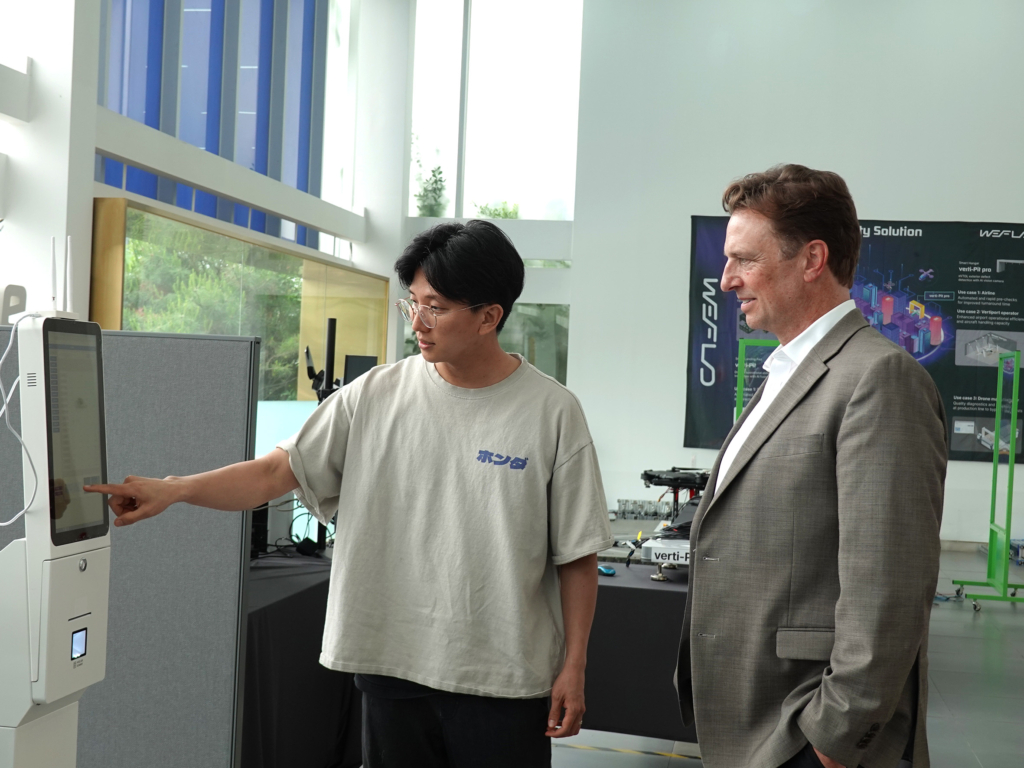
Q. Please introduce us to WEFLO.
WEFLO is a company that wants to make flying systems safer and freer.
The reason why the AAMs being developed now take a long time is because of safety.
It would have been developed much faster if we hadn’t considered safety.
Safety is the top priority because people ride, and by securing that safety with WEFLO.
We aim for a world where we can run freer and safer.
Q. Could you explain it in more detail technically?
Our biggest feature is that we inspect the drive in a contactless manner.
The existing aircraft inspection system is difficult to inspect the driving part.
To inspect the drive, you have to actually operate it, but it’s hard to turn the engine on and off,
There was no such procedure itself in the existing process.
Whenever I flew a drone, I saw it with my eyes and flew when it started, but there was no systematic check.
That’s what we’re trying to do. However, it is practically difficult to attach sensors to moving objects.
If you attach something to a rotating part, it can twist the line or fly to centrifugal force, but it creates a risk of an accident.
That’s why the direction of contactless sensors naturally came out.
Of course, contact sensors can be much more comfortable and accurate. If you attach the vibration sensor directly to the gas, it is resistant to external noise.
On the other hand, non-contact sensors, for example, sound sensors, are the same principle as microphones, so all external noise comes in.
Our technology is to extract important features well within the noise.
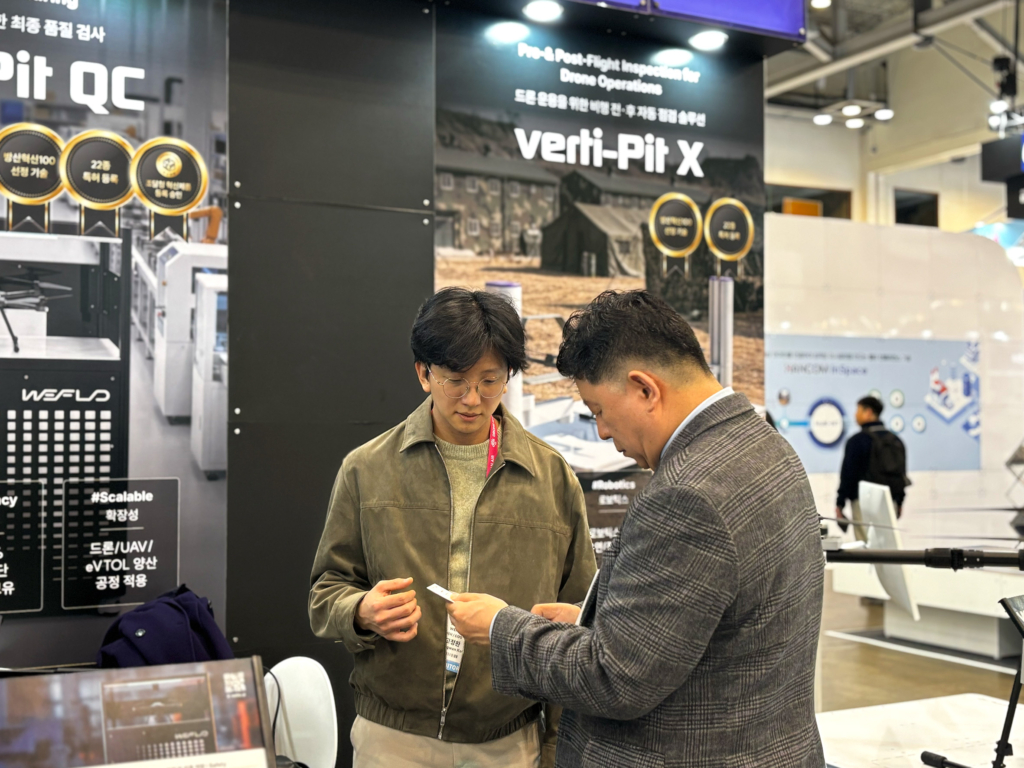
Q. How is the diagnosis done after collecting data with sensors?
There are two main layers of diagnosis.
The first is an area that is easy to quantify.
It’s “fault” when the motor doesn’t run at all, and it’s “abnormal” when it’s running a little slower
But it’s very difficult to set the standard for this ‘ideal’. Cars have no problem driving even if there is an abnormality on one side of the wheel,
On the aviation side, depending on the level above that, the entire system can lead to a crash.
The best thing is to get the data from the aircraft manufacturer and set the standard,
If that is difficult, we set different criteria for each gas by simulation and statistical methods.
It is our technology that sets this standard accurately.
The second is the area that appears only as a pattern.
For example, if there is a resistance inside the motor or an open circuit or short circuit,
This one is out of RPMLike this, it’s not visible, but only data patterns.
If you add external environmental noise, it’s really hard for humans to judge.
Just as craftsmen heard sounds and sensed abnormalities in the past, it can be said that the craftsman’s know-how was melted into AI.
Q. The drone itself also has a sensor, so why does WEFLO see it from the outside?
The drone’s internal sensors are for maintaining your posture, not for checking your health.
Let me give you an example.
One of the key technologies that allow small drones to fly even on a small scale these days is the ‘senseless BLDC motor’.
Originally, to turn the motor, you need a sensor that measures how it rotates,
A technology that operates only by estimation without that sensor was developed.
However, because it is an ‘estimation’, it is less accurate than the actual measurement.
We do actual measurements from the outside.
As another example, there may be a situation where the motor rotates, but the propeller does not.
With the gas internal sensor, you need to increase the speed more to know.
If one side doesn’t turn, it tilts, and the control system gives more force to the other side, but the propeller is not attached, so it eventually turns over.
We measure the motor rotation speed and the propeller’s own rotation speed with our own sensor, so you can see the difference between the two right away.
You can measure things that can never be seen by an internal gas sensor, such as whether it slips or is in the right direction.
Q. How far can WEFLO’s technology extend in the future?
In the short term, it’s linked to authentication.
Drones need to be approved for flight before flying under a lot of conditions,
It’s administratively difficult and it’s hard to make a bet every time.
Check the gas condition through our diagnostic pad,
Compared to the registered criteria, “If you’re in this health condition, it’s okay to fly.”
One milestone is to get to the system where permission is automatically issued.
If you look at it longer, it’s foresight maintenance.
If drones are used in all industries, about 100,000 will fly every day,
At that time, predicting the life cycle of 100,000 units or managing inventory becomes very important.
I don’t know when the motor will fail and when to replace the battery
We are dreaming of a system that automates the entire maintenance system by predicting it with our sensor data.
And not only in the diagnostic area, but also in the production line, quality management, and automation of operational inspection,
In the end, if a drone system is to be operated unattended, all human inspections must be automated.
The ultimate goal is to create the whole thing.
Q. What kind of world do you think this technology can ultimately create?
Whether it’s drones or AAM, there will be an era where various mobility systems are operating closely.
The competitiveness at that time isn’t about flying or how many people you’re going to get on It’s going to be “how safe and sustainable you can operate.”
From that point of view, our diagnostic technology is more of an infrastructure than an auxiliary feature.
The air condition is quickly and accurately identified to increase operational efficiency, and the maintenance system is advanced based on this,
The credibility of the industry as a whole goes up.
Abstractly speaking, we’re getting closer to a world where the vehicle can explain its own state.
We don’t speak directly when we’re sick, but as a doctor diagnoses it or a smartwatch tells us.
WEFLO is working on laying the groundwork for the flying vehicle,
It started with drones now, but we are trying to expand into a wider area of electric mobility such as AAM and electric vehicles.
In the next installment, we will define our role as CTO, the culture of the WEFLO technical team, the experience of the most rewarding projects and failures, and our vision 10 years from now
— I will talk about the ‘how to work’ of CTO Kim Young Won.