Reading Propulsion Health from Current, RPM, Vibration, and Temperature
The early signs a drone motor shows before it fails
A drone’s motors spin thousands to tens of thousands of times per minute throughout a flight, continuously carrying the weight of the aircraft. In a multirotor especially, several motors generate thrust together to hold attitude, so trouble in a single propulsion unit can meaningfully change flight stability on its own.
So does motor failure strike all at once? Some failures do happen abruptly with little warning, such as an electrical short or an ESC fault. But faults that develop over time, like bearing wear, rotor imbalance, or sustained overload,
tend to leave traces in current, rotational speed (RPM), vibration, and temperature well before the motor stops completely. In practice, these are exactly the signals used in BLDC motor condition diagnostics.
When the same command gets a different response
The most intuitive signal is the relationship between current and RPM. If one motor draws more current than before for the same commanded output, or fails to reach the expected RPM, it is worth examining whether the propulsion unit’s efficiency has changed. PX4, for example, uses whether the current reported by an ESC falls outside the range expected for the commanded thrust as an input to its motor failure detection. ESCs with telemetry can report not only RPM but also current, voltage, and temperature. The important caveat is that high current alone does not confirm a motor fault. A change in propeller load, the ESC, the wiring, or another mechanical issue can produce the same reading.

Vibration shows up before the eye can
When a bearing wears, a shaft falls out of alignment, or a propeller loses balance, the motion of the rotating assembly changes too. These shifts can appear in vibration signals at a stage still invisible to the naked eye. Studies on bearing faults in BLDC motors likewise treat vibration and temperature as primary signals for early detection, and research suggests that combining two or more signals can be more reliable for assessing condition than analyzing any single one. That said, vibration is not an answer key that points straight to the cause. It can originate not only from the motor but also from propeller damage, fastening condition, or the airframe structure. Even when a flight log flags a mechanical anomaly, confirming whether it is the motor, the ESC, or the propeller takes further investigation.
A change in temperature is a signal too
Excessive load, friction, and electrical losses can surface as heat. If a particular motor or ESC runs consistently hotter under the same operating conditions, a change in condition is worth suspecting. Many current ESCs,
depending on the model, now pass RPM, current, voltage, and temperature through to the flight controller. In other words, the environment to view propulsion condition not simply as “spinning or not spinning” but as the movement of multiple data points is already taking shape.
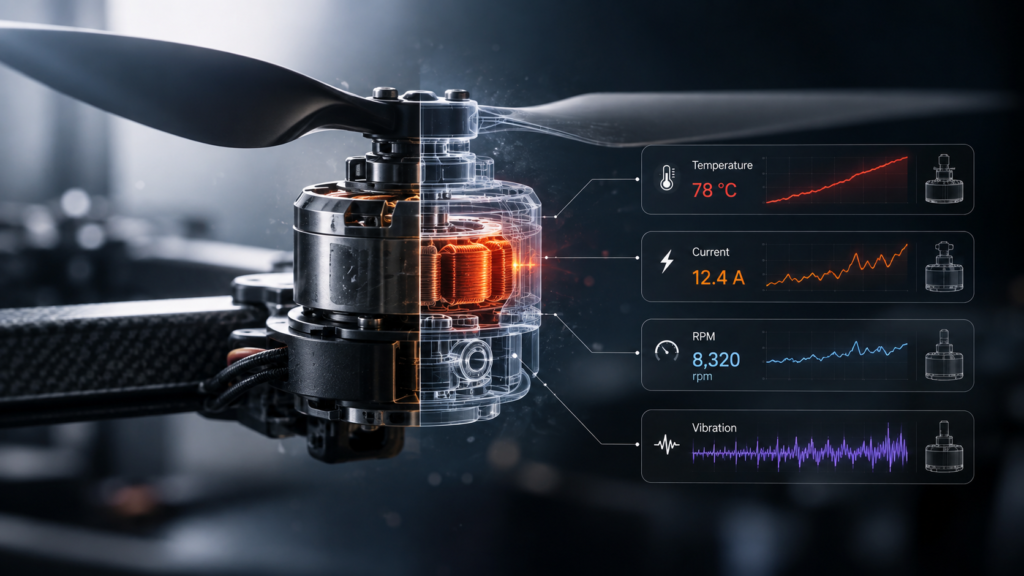
What matters is not a single number, but a change in the relationships
The biggest trap in reading motor condition is drawing the line between healthy and failing on a single threshold. A rise in current is not necessarily a fault, and more vibration does not by itself pin the problem to a specific part.
Conversely, even when each value sits within its allowable range, a pattern where RPM is dropping while current and temperature keep climbing is reason to look closer. So in judging condition, what matters is less any single measurement than what has changed from before under the same conditions, and which direction several signals are moving in together. A motor that is still spinning is not the same as a motor that is spinning normally. Failure may not begin at the moment the motor stops. That is why how quickly you catch the signals that changed beforehand is what counts.