WEFLO Introduces Drone Safety Diagnostics Solution at CES
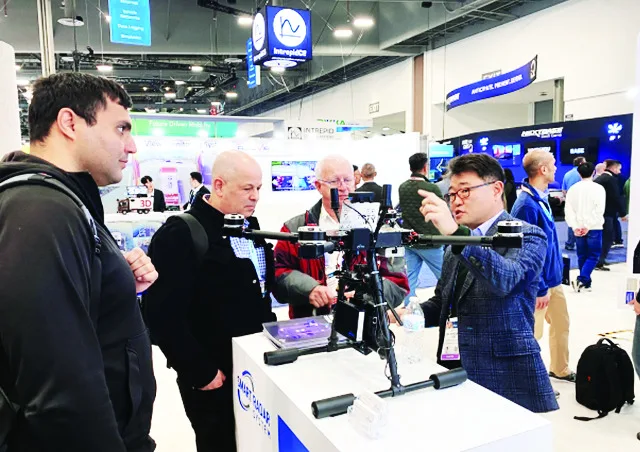
At the world’s largest home appliance information technology (IT) exhibition ‘CES 2024’ held in Las Vegas this year, 143 domestic ventures and startups won the most ever. About 46% of the total 310 award-winning companies were Korean companies, with 128 startups winning. Startups that indirectly show how the future mobility environment will change drew attention.
“Smart Radar System,” which participated in CES for three consecutive years, is a startup that makes radar sensors that act as eyes for level 3 autonomous vehicles that allow drivers to drive with their hands off the steering wheel. This year, the company introduced a ‘four-dimensional (4D) imaging radar’. It is a radar that helps you accurately grasp your surroundings by applying deep learning technology to data that combines three-dimensional information (distance, speed, angle) and height information of surrounding objects. An industry official explained on the 23rd, “4D imaging radar sensors support height measurements that are not supported by existing radars and reduce power consumption by one-eighth of the number of antennas compared to competitors.” Smart Radar System recently won a contract to develop a radar for a delivery drone used in Amazon’s ‘Prime Air’ service in the United States.
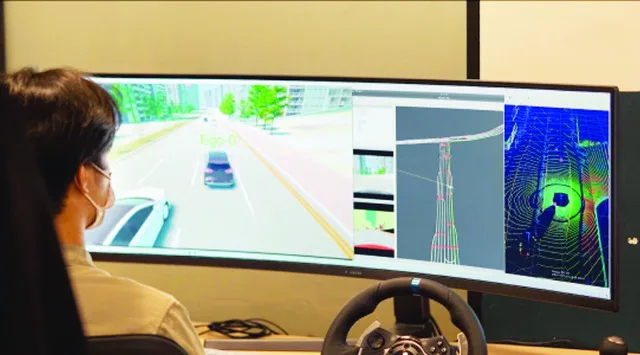
The self-driving simulation of “Morai” also attracted attention.Morai, which participated in CES for five consecutive years, is a startup created by KAIST autonomous vehicle researchers in 2018.In the meantime, global automakers and autonomous driving startups have tested autonomous driving technology with real vehicles.Morai enabled testing in virtual space through the autonomous driving simulation platform “Morai Sim”.A road and lane simulation environment was created with precision map data.In particular, by creating actual traffic conditions, data necessary for verifying the safety and reliability of autonomous vehicles can be obtained.Morai is working with autonomous vehicles as well as autonomous aviation and ship companies.
At CES Eureka Park, where only startups can participate within five years of business, companies using artificial intelligence (AI) technology drew attention. Founded in 2021, ‘TJ Labs’ is an indoor location recognition solution company. Indoor positioning is considered a tricky technique. This is because it is difficult to use satellite-based location services (GPS) indoors unlike outdoors. TJ Labs allowed AI to analyze information received through applications (apps), tags, and de-identified mobile devices to identify locations. It can detect objects moving indoors, such as people, cars, and equipment. It is also possible to analyze data such as the number of real-time visitors, density, and cumulative viewing time, and to identify visitors’ travel routes and areas of interest. This solution is provided to Kakao Navi, KINTEX, etc.
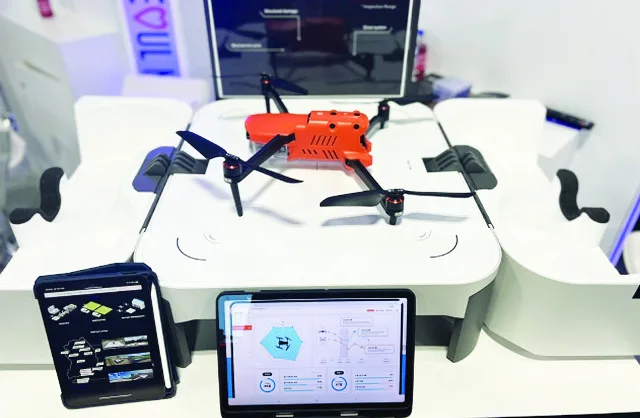
The drone station of “WEFLO” also attracted attention. Founded in 2022, WEFLO is developing a safety diagnosis solution for flying vehicles. The goal is to automate safety inspections in a non-destructive and contactless manner from future aviation mobility (AAM) to drones. Safety diagnosis is essential for aircraft as defects lead to human accidents. The “Bertifit,” an aircraft landing site that applies big data and AI technology, checks for defects in the outside and inside of the aircraft within seconds before takeoff. Last year, WEFLO and the Ministry of Land, Infrastructure and Transport established Vertipit in 15 locations across the country.